Source & Concept
Origins. Influences. Architecture.
Before the machine wandered through history, there was only a collection of references, questions, experiments, and personal fascinations. This section documents the origins of The Accidental Editor: the ideas, influences, and structural decisions that transformed a challenge submission into an archival narrative.
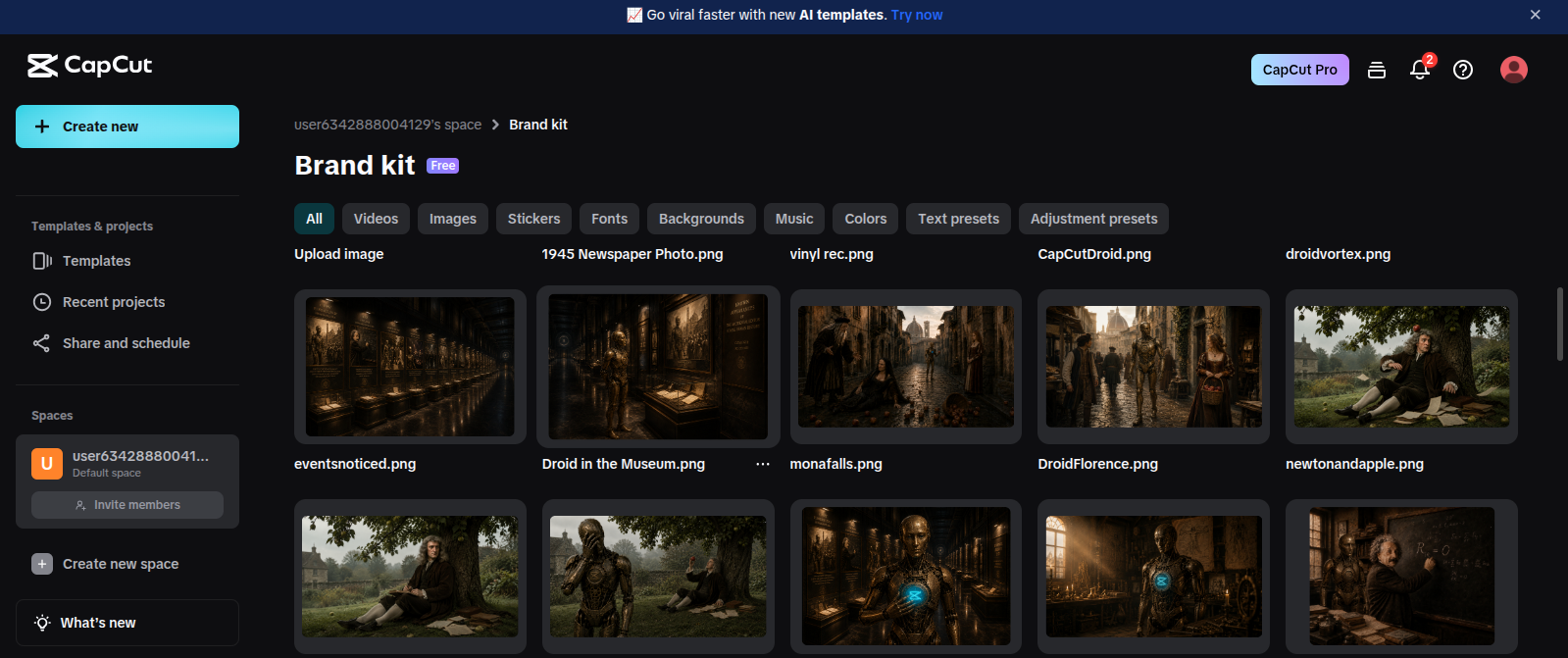
Collecting The Fragments
The project began with collecting source materials rather than writing a script.
Challenge assets, generated imagery, historical references, production experiments, exhibition concepts, and narrative fragments were gathered first. Instead of approaching the project as a linear story, the initial goal was to build a collection large enough to discover what story wanted to emerge from it.
The archive came before the narrative.
Why A Machine?
Long before this project existed, machines had already become a recurring creative subject.
As both a historian and archivist on one side and an AI developer and builder on the other, I often found myself working between two worlds: preserving traces of the past while simultaneously helping create new technological systems.
The machine became a natural bridge between those worlds.
Not because machines replace humanity, but because they reveal it.
A machine wandering through history would not understand art, science, music, invention, or memory the way people do. Yet its attempts to understand them could expose something important about how humans leave traces behind.
The Accidental Editor emerged from that idea.
Why The Renaissance?
The Renaissance felt like the only appropriate beginning.
Its roots in classical Greece and Rome, its explosion of artistic achievement, scientific curiosity, experimentation, engineering, and intellectual ambition represent one of the most important turning points in human history.
It was a period where disciplines were not yet isolated from one another.
Art, science, architecture, engineering, philosophy, and invention existed side by side. That spirit closely mirrors how modern creative technology often operates today.
The Renaissance therefore became more than a historical setting. It became the philosophical foundation of the project itself.
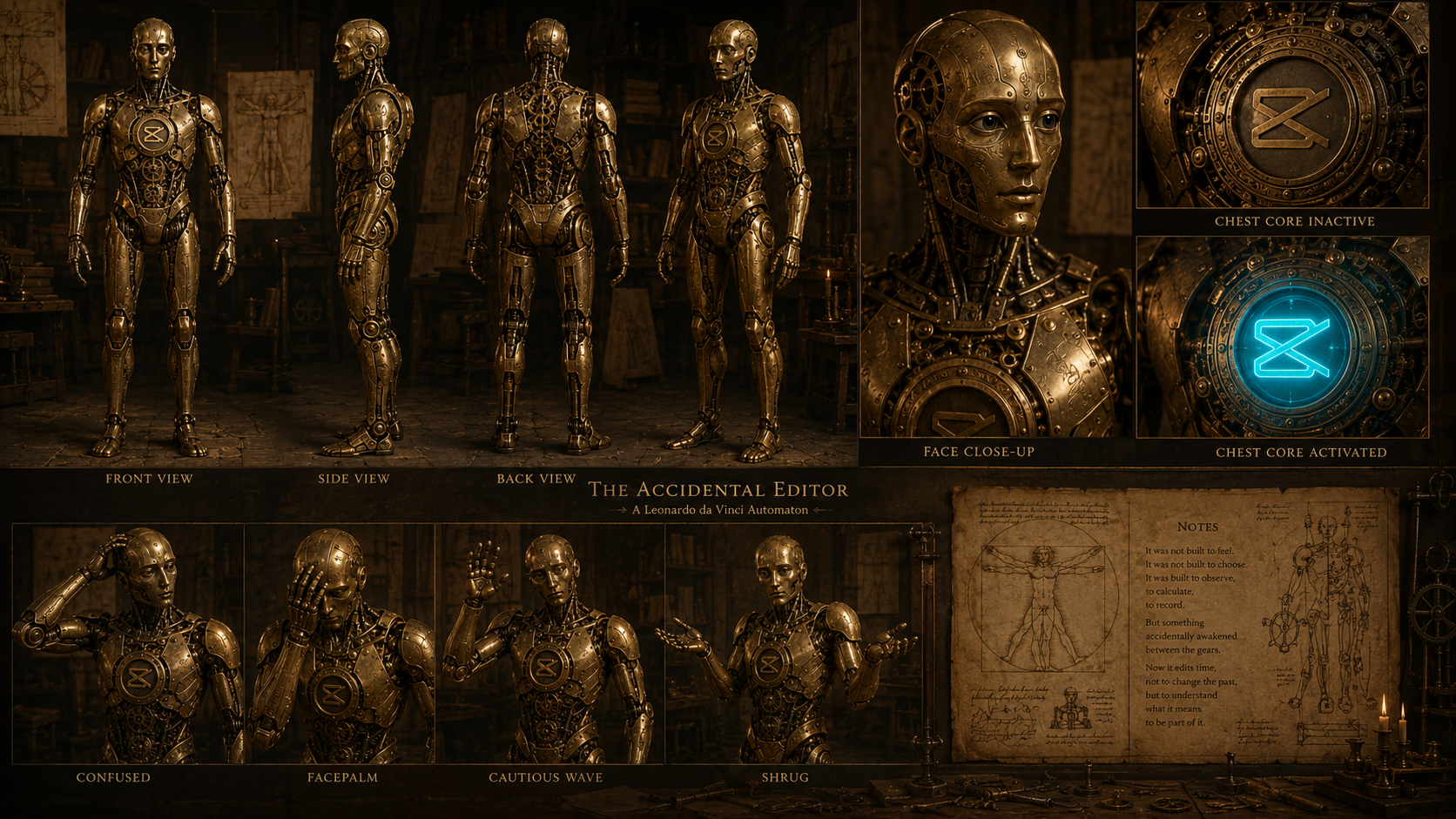
Why Leonardo?
If a machine capable of wandering into history could plausibly exist within the narrative, Leonardo da Vinci felt like the only believable creator.
His notebooks contain designs for machines centuries ahead of their time.
His work constantly crossed boundaries between engineering, anatomy, mechanics, art, architecture, and observation.
The project does not present Leonardo as a historical fact-builder of the automaton. Instead, it treats him as a symbolic origin point — a creator whose curiosity was large enough to imagine something impossible.
The Accidental Editor begins in Leonardo's workshop because that is where invention, imagination, and experimentation naturally converge.
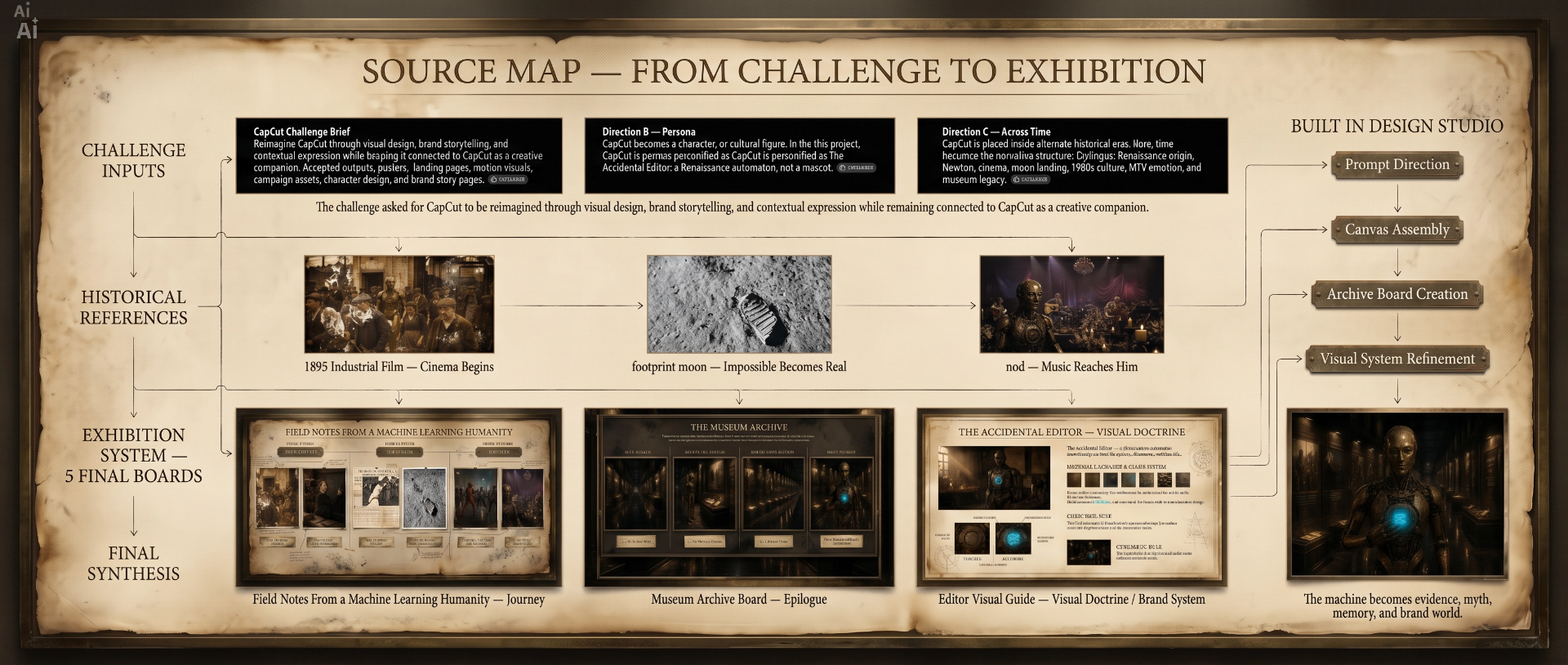
Finding The Story
The narrative did not arrive fully formed.
It emerged gradually through connecting historical moments, visual experiments, challenge materials, and production concepts.
One question eventually became the foundation of the entire project:
"What happens when a machine built to edit media accidentally begins editing history?"
From that premise emerged a wandering automaton moving through impossible moments of human culture, collecting fragments of invention, science, memory, music, art, and human experience.
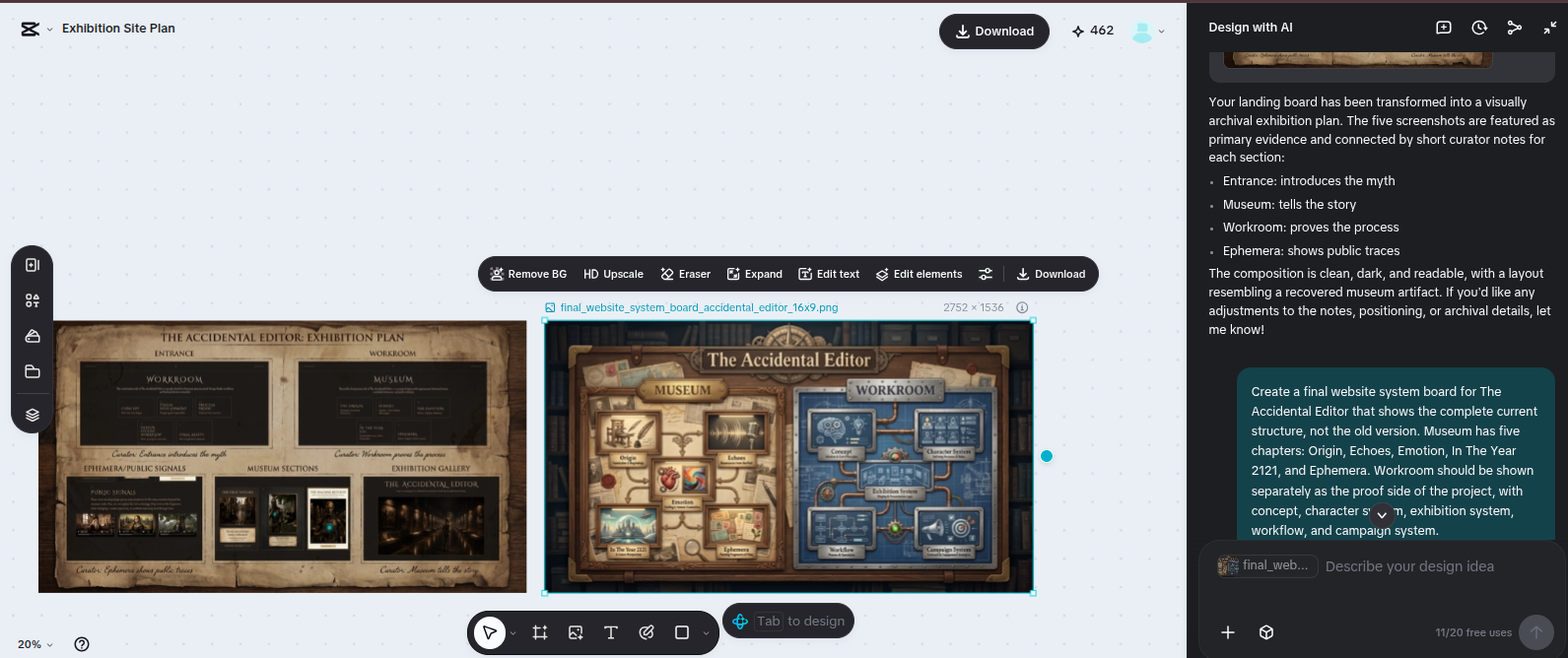
Building The Structure
Once the narrative direction became clear, the next challenge was architectural. The project required a structure capable of presenting both the fictional archive and the real creative process behind it.
Several approaches were explored before the final system emerged.
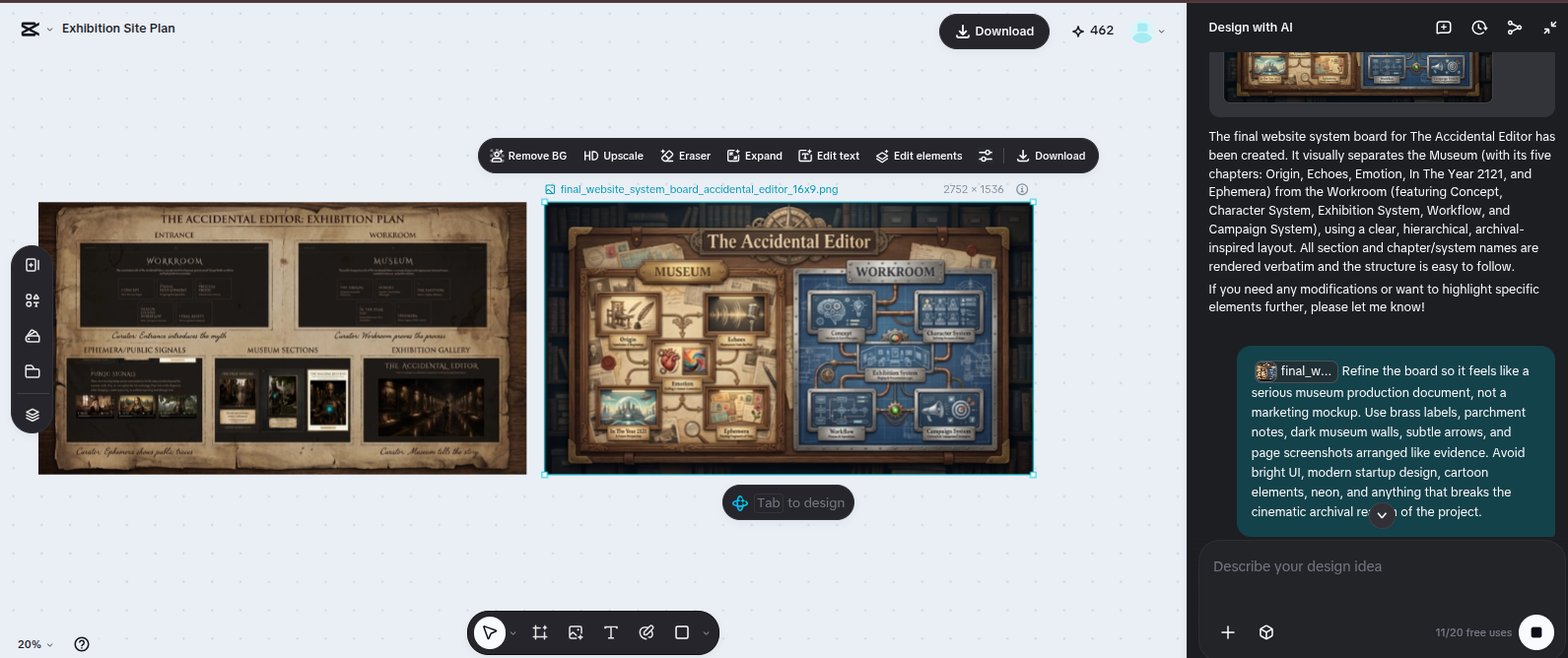
System Refinement
Museum and Workroom sections begin to take recognizable form, establishing relationships between story, evidence, and process.
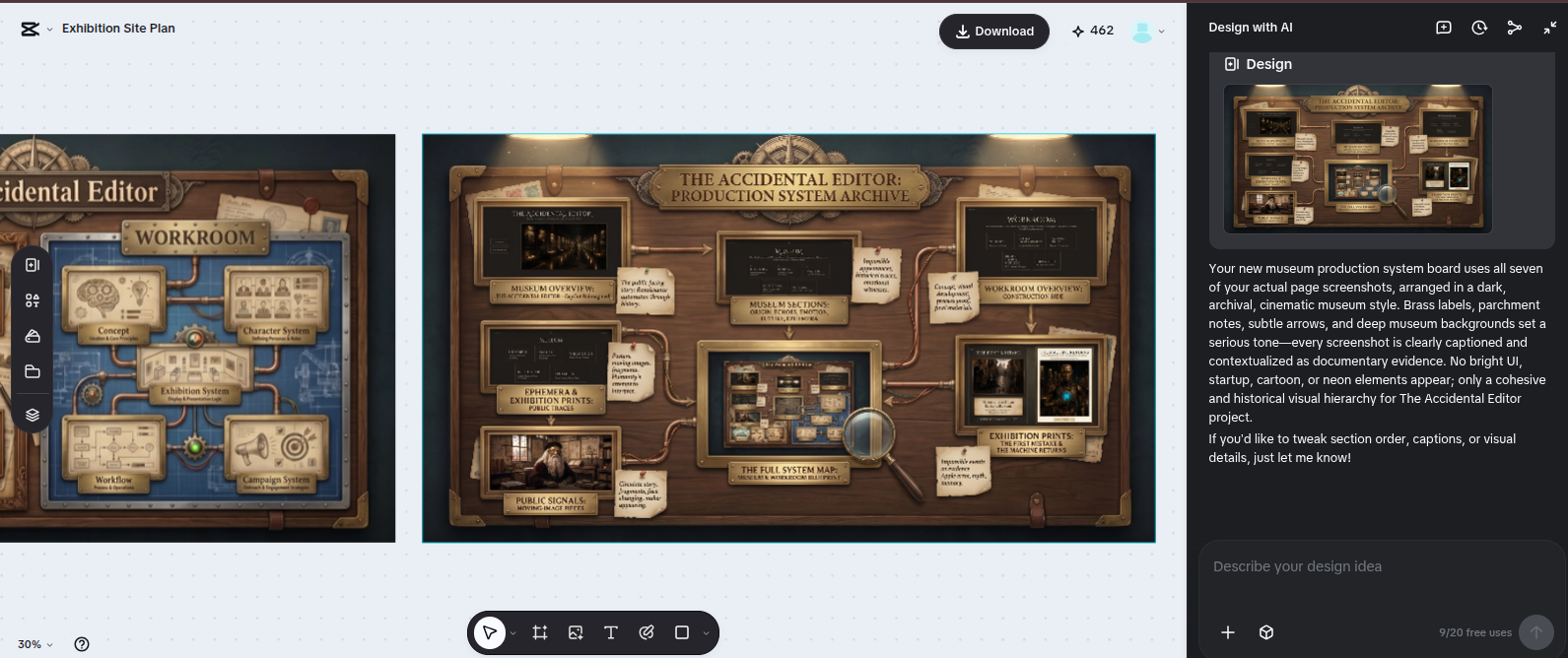
Approved Architecture
The final structure separates the project into two connected environments.
The Museum presents the completed narrative through exhibitions, field notes, public traces, historical fragments, and collected evidence.
The Workroom documents the real process behind the project: concept formation, visual development, production decisions, experimentation, system design, and final assembly inside CapCut Design Studio.
Together they form a complete archive. One documents the fiction. The other documents its creation.
Foundation Established
With the source materials collected, the narrative identified, and the architecture approved, development could finally begin. The next stage focused on establishing the visual language of the project, defining the appearance of the automaton, and building a coherent artistic system capable of carrying the story from Renaissance Florence to the modern world.